วันอาทิตย์ที่ 23 พฤศจิกายน พ.ศ. 2557

Tea Ceremony

Japanese Tea Ceremony


The Japanese Tea Ceremony

The Japanese tea ceremony, or chanoyu (hot water for tea in Japanese), came about when Japan adopted both Chinese practices of drinking powdered green tea and Zen Buddhist beliefs.  In the 1500s, Sen No Rikkyu incorporated the ideas of simplicity and that each meeting should be special and unique into the tea ceremonies.  The traditional Japanese tea ceremony became more than just drinking tea; it is a spiritual experience that embodies harmony, respect, purity and tranquility.

The host of the tea ceremony may prepare extensively for the event, practicing hand movements and all steps so that the ceremony is perfect, yet simple in every detail. The ceremony can be performed in the home, a special tea room, in a tea house, even outdoors.  The décor for the ceremony is simple and rustic and includes hanging scrolls (kakemono in Japanese) that are appropriate for the season or feature well known sayings.
Chanoyu1

Steps of the Japanese Tea Ceremony


Step 1: The Host Prepares for the Ceremony
Preparation for the tea ceremony sometimes starts weeks earlier before the actual day when the ceremony takes place. The host needs to send formal invitations to the guests and to prepare his/ her soul for the ceremony by leaving behind all worldly thoughts and just focusing on obtaining a certain harmony and equilibrium within himself or herself.
Step 2: The Guests Prepare for the Ceremony
The guests also need to prepare spiritually for the ceremony before actually participating. They need to purify their hearts and thoughts and leave the worldly worries behind.
Before entering the tea room or garden where the ceremony will be held, the guests have to wait for the signal of the host which will announce them that the host is ready to receive them. They also need to wash their hands in an attempt to symbolically get rid of the “dust” from the outside world.
After the host gives them the signal, they will enter the tea room through a small door which obliges them to bow as a sign of respect to the host and to the preparations she or he has made.
Step 3: Cleaning the Tools
The actual preparation of matcha doesn’t start until the host brings in the tools, cleans them in front of the guests before using them. The cleaning of the tools is aesthetically done with concentration and highly graceful movements.
These movements can differ from a type of ceremony to another, but what is always important  in all the Japanese tea ceremonies is the graceful posture of the host and aesthetic value of the way things are done during the ceremony. No unnecessary movements or words are allowed during the ceremony, all the things starting with the tools and ending with the guests’ behavior have to be in harmony with each other.
Step 4: Preparing Matcha
After the tools are perfectly clean and aesthetically displayed, the preparation of matcha begins. We have dedicated an entire article to matcha green tea, so feel free to check it out for detailed explanation regarding matcha preparation. Usually the host adds in the tea bowl three scoops of matcha per guest. After adding the powder, the hot water is also added to the bowl and the composition gets whisked into a thin paste. More water is added afterwards.
Step 5: Serving Matcha
The host presents the prepared tea bowl to the main guest and they exchange bowls.  This first guest admires the bowl then rotates it before taking a drink.  The guest wipes the rim of the tea bowl then offers it to the next guest who repeats these movements. These movements are repeated until the bowl reaches the last guest which passes it back to the host.
Step 6: Completing the Ceremony
After all the guests have taken a drink of tea, the host cleans the bowl. The host will also rinse and clean the tea whisk and scoop again.
The guests need to inspect the tools used in the ceremony after they have been cleaned as a sign of respect and admiration for the host. They carefully and respectfully examine the utensils  using a cloth when handling them with extreme caution. After this phase is over, the host gathers the tools and the guests exit with another bow to complete the ceremony.

Chanoyu2

Ceremonial tea-room

A ceremonial tea-room is usually about three meters square (a four-and-a-half tatami-mat room) and is decorated very simply. The spirit of "wabi" is exemplified by this tea-room.

ceremorial-tea-room

Nijiri-guchi: a side door about 60 cm square through which guests enter the tea-room. Since they are forced to bow when passing through this door, they naturally lose their sense of self-importance and become humble.
The style of cha-no-yu depends on the school, such as Ura-Senkê, Omotê-Senkê, etc. The style described above is primarily that of Ura-Senkê.


Onsen (Japanese Hot Springs)

Onsen (Japanese Hot Springs)


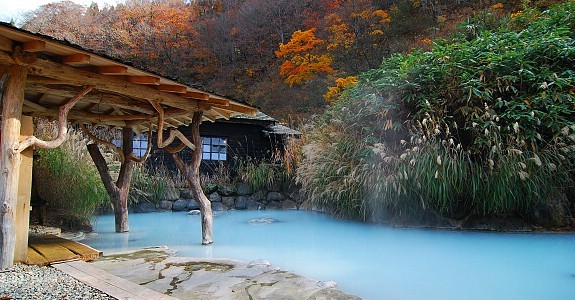
Natural hot springs (onsen) are numerous and highly popular across Japan. Every region of the country has its share of hot springs and resort towns, which come with them.
There are many types of hot springs, distinguished by the minerals dissolved in the water. Different minerals provide different health benefits, and all hot springs are supposed to have a relaxing effect on your body and mind.
Hot spring baths come in many varieties, indoors and outdoors, gender separated and mixed, developed and undeveloped. Many hot spring baths belong to a ryokan, while others are public bath houses. An overnight stay at a hot spring ryokan is a highly recommended experience to any visitor of Japan.

Outdoors
Indoors
Nothing beats a visit to a hot-spring ryokan for easing away the stress of modern life. Sharatei offered Warner and Birtles a calming soak, peaceful gardens for strolling, a dinner of seasonal delicacies, and refined traditional architecture. Being from Britain, they began to chat about the much-anticipated revival of hot-spring bathing in the city of Bath, where the bathing tradition began in England during the days of the Roman Empire.


Japan Tradition Costumes

Kimono

The kimono is the traditional dress of Japan, and it is worn nowadays on formal occasions. It is sometimes accused of being an impractical form of dress, but it has the advantage of giving the wearer a graceful and elegant deportment.
ladie's-Kimono


There are various different types of kimono for use at different times and on different occasions. Women's kimono include the furisodé and tomesodé for formal wear, the hômongifor paying calls, the tsukesagé, and the komon. Men's kimono include the montsuki hakamafor ceremonial occasions and the haori for going out visiting. There is also the yukata, worn by both men and women as informal dress at home, in ryokan or for attending local festivals.
men's-Kimono

The shape of kimono is fixed, and individuality is achieved by careful selection of the material, the style of weaving and dyeing, the color, and the pattern, as well as by the choice of obi.

Obi

Footwear

Zôri and geta are the well-loved traditional footwear of Japan. They both have a Y-shaped thong which is gripped between the big toe and the second toe and passes over the top of the foot.
Hakimono
Zori and Geta


Top 10 Japan Foods

Sushi


Put simply, sushi is raw fish served on rice seasoned lightly with vinegar. It’s in the variety of flavours and textures – like tangy, creamy uni (sea urchin roe) and plump, juicy, ama-ebi(sweet shrimp) – that things get interesting. Despite sushi’s lofty image, it has a humble origin: street food.

Ramen

Ramen, egg noodles in a salty broth, is Japan’s favourite late night meal. It’s also the perfect example of an imported dish – in this case from China – that the Japanese have made completely and deliciously their own. There are four major soup styles: tonkotsu (pork bone), miso, soy sauce and salt. Fukuoka is particularly famous for its rich tonkotsu ramen; pungent miso ramen is a specialty of Hokkaido. 

Unagi

Unagi is river eel grilled over charcoal and lacquered with a sweet barbecue sauce. According to folklore, unagi is the ideal antidote to the heat and humidity of Japan’s stultifying summers. It’s a delicacy evocative of old Japan and most restaurants that specialize in eel have a wonderfully traditional feel. Fresh, wild-caught unagi is available May through October.

Tempura


Light and fluffy tempura is Japan’s contribution to the world of deep-fried foods (though it likely originated with Portuguese traders). The batter-coated seafood and vegetables are traditionally fried in sesame oil and served with either a tiny pool of salt or a dish of soy sauce-flavoured broth spiked with grated radish for dipping. Do not miss out on ebi-ten(tempura prawns).

Soba


Soba – long, thin buckwheat noodles – has long been a staple of Japanese cuisine, particularly in the mountainous regions where hardy buckwheat fares better than rice. The noodles are served in either a hot, soy sauce-flavoured broth or at room temperature on a bamboo mat with broth on the side for dipping. Purists, who bemoan soup-logged noodles, prefer the latter. 

Okonomiyaki


Literally “grilled as you like,” okonomiyaki is Japanese comfort food at its best, and a clear violation of the typical refined image of Japanese food. It’s a savoury pancake filled with any number of things (but usually cabbage and pork) and topped with fish flakes, dried seaweed, mayonnaise and a Worcester-style sauce. It’s also a lot of fun: At most restaurants, diners grill the dish themselves at a hotplate built into the table.

Tonkatsu


Tonkatsu, breaded and deep-fried pork cutlet, dates to the late 19th Century when Japan threw open its doors to Western influence. But never mind the European origin: the ingredients and attention to detail are thoroughly Japanese. Tonkatsu – especially when it’s kuro-buta(Berkshire pork) from Kagoshima – is melt-in-your-mouth tender, served with a side of miso soup and a mountain of shredded cabbage.

Yakitori

A cold beer and a few skewers of yakitori – charcoal grilled chicken – is an evening ritual for many of Japan’s weekday warriors. Nearly every part of the chicken is on the menu, all grilled to perfection, seasoned with either shio (salt) or tare (a sweet soy sauce-based sauce) and served with a side of friendly banter.

Shabu-Shabu

Shabu-shabu is the Japanese onomatopoeia for the sound of thin slices of beef or pork being swished around with chopsticks in bubbling broth. It’s a decadent dish, with platters of marbled meat brought to the table for diners to cook themselves – it takes only a moment – one mouthful at a time.

Kaiseki

Part dinner, part work of art, kaiseki is Japan’s haute cuisine. It originated centuries ago alongside the tea ceremony in Kyoto (and Kyoto remains the capital of kaiseki). There’s no menu, just a procession of small courses meticulously arranged on exquisite crockery. Only fresh ingredients are used and each dish is designed to evoke the current season.

Top 5 Japan's interesting places

  1. 1. Mount Fuji, located on Honshu Island, is the highest mountain in Japan at 3,776.24 m. An active stratovolcano that last erupted in 1707–08, Mount Fuji lies about 100 kilometres south-west of Tokyo, and can be seen from there on a clear day.
  2. Elevation3,776 m
  3. Last eruptionDecember 16, 1707
  4. Prominence3,776 m
  5. First ascent663 AD
Fuji mountain


2. Fushimi Inari Taisha is the head shrine of Inari, located in Fushimi-ku, Kyoto, Japan. The shrine sits at the base of a mountain also named Inari which is 233 metres above sea level, and includes trails up the mountain to many smaller shrines which span 4 kilometers and takes approximately 2 hours to walk up.
Since early Japan, Inari was seen as the patron of business, and merchants and manufacturers have traditionally worshipped Inari. Each of the torii at Fushimi Inari Taisha is donated by a Japanese business. First and foremost, though, Inari is the god of rice.
Fushimi Inari Taisha

3. Itsukushima is an island in the western part of the Inland Sea of Japan, located in the northwest of Hiroshima Bay. It is popularly known as Miyajima, which in Japanese means the Shrine Island.The island is one of Hayashi Razan'sThree Views of Japan. Itsukushima is part of the city of Hatsukaichi in Hiroshima Prefecture. The island was the town ofMiyajima before the 2005 merger with Hatsukaichi.
The island of Itsukushima, including the waters around it (part of Seto Inland Sea), are within Setonaikai National Park. This sea is affected by strong tides. At low tide, the bottom of the sea is exposed past the island's torii. At high tide, the sea covers all the previously exposed mud and fills areas underneath the shrine.
Itsukushima

4. Universal Studios Japan located in Osaka, is one of four Universal Studios theme parks, owned and operated by USJ Co., Ltd. with a license from NBCUniversal. The park is similar to the Universal Orlando Resort since it also contains selected attractions from Universal Orlando Resort and Universal Studios Hollywood. Most visitors are Japanese tourists and tourists from other Asian countries such as Taiwan, Hong Kong, and South Korea. In 2005 Goldman Sachs became the largest shareholder in Universal Studios Japan. The park opened on March 31, 2001. Visitors to the park the opening year reached 11 million guests, becoming the world’s fastest amusement park to achieve the 10 million milestone at the time. Since then, Universal Studios Japan has had approximately 8 million visitors every year.

Universal Studio Japan
5. Osaka Aquarium Kaiyukan  is an aquarium located in the ward of Minato in Osaka, Japan, near Osaka Bay. It is one of the largest public aquariums in the world, and is a member of the Japanese Association of Zoos and Aquariums (JAZA).
The aquarium is about a five-minute walk from Osakako Station on the Osaka Municipal Subway Chūō Line, and is next to the Tempozan Ferris Wheel.

Osaka Aquarium Kaiyukan